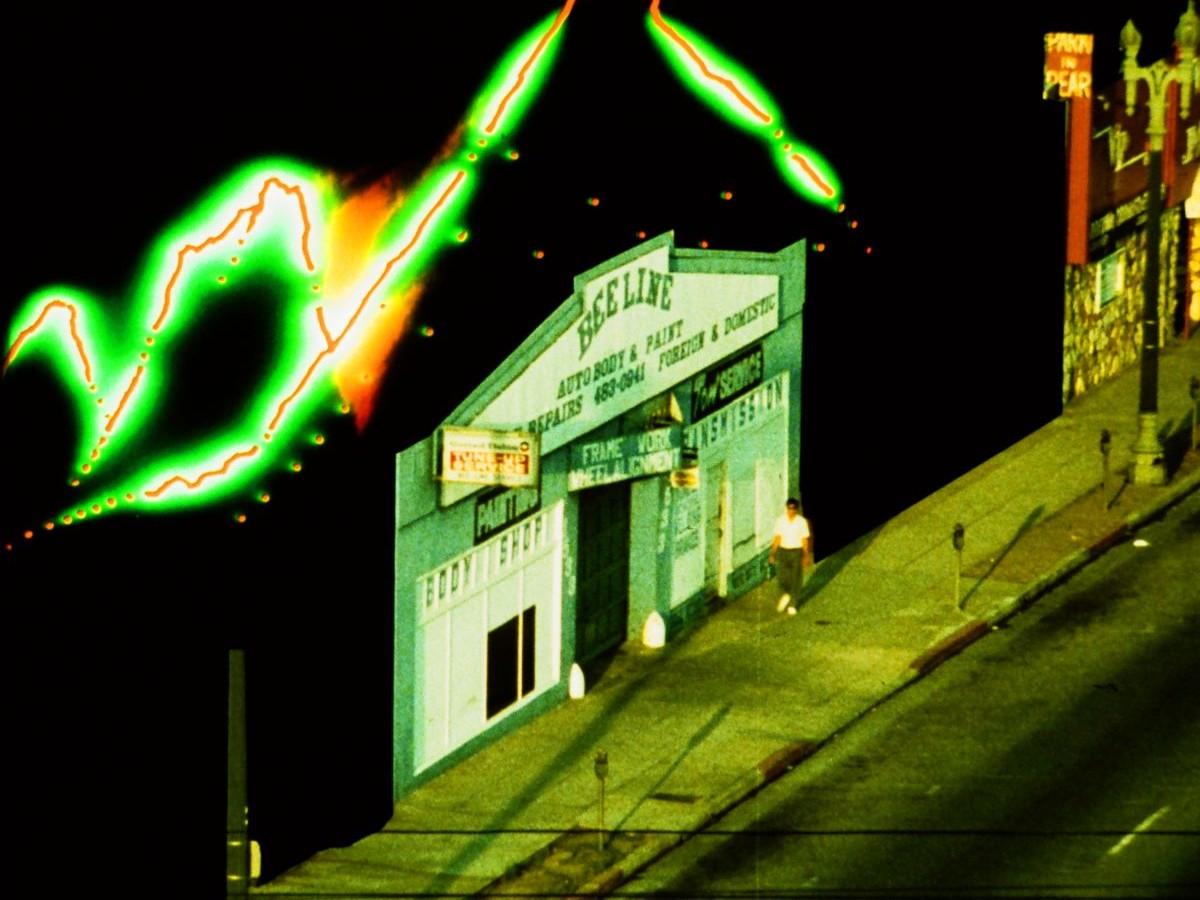
Los Angeles
A City in Film
October 5 to November 5, 2008
This year's joint Retrospective of the Austrian Film Museum and the Viennale – Vienna International Film Festival is dedicated to a city which is more closely attached to the medium of film than any other place in the world: Los Angeles, home to a vast industry called "Hollywood", but also to many independent film movements which have opened up new perspectives both on cinema and our imagination of Los Angeles. The show is curated by the filmmaker and scholar Thom Andersen, whose epic film essay Los Angeles Plays Itself (2003) is one the most highly acclaimed films of recent years. With the Retrospective, Andersen expands on his film’s approach: due to his detailed knowledge of the city, its history and its film cultures, he creates a fascinating portrait of the real Los Angeles, oscillating between film noir and the avant-garde, Academy-Award winning classics and the gay underground, critical film essays and roaring genre flicks, slapstick comedies and rock music.
"Los Angeles, it seems, continues to fascinate people around the world although its time as ‘the city of the future’ has long passed. Is it simply the movies? Because Los Angeles has been the production center of the American motion picture industry for almost one hundred years, images of the city have been projected into the minds of many million people throughout the world. In the early days of the movies, these images were used to promote a city that had nothing to sell except itself. When the city lost its self-confidence in the 1960s, these images turned darker but they became even more fascinating. If the city of the future had failed, how could the cities of the past survive?
So Los Angeles has become a proving ground for the intersection of movies with the real world. ‘You can never be as radical as reality,’ Lenin said, and in my movie Los Angeles Plays Itself, I tried to demonstrate how Hollywood film-makers had often spurned this challenge, misreading and misrepresenting the city and its history. In this program, we are attempting something different by presenting films that engage the claims of reality, that present a ‘true, valid and useful image’ (to quote Wenders on Ozu) of Los Angeles and its people. Some of these were considered briefly in Los Angeles Plays Itself, but they have never been shown in Austria, such as Bless Their Little Hearts (1984) by Billy Woodberry. Others are only now becoming available in proper prints, such as The Exiles by Kent Mackenzie, which finally received a theatrical run in New York City this summer, fifty years after production on the film began, and was greeted as a great revelation.
There were many other films I admire just as strongly for which I couldn't find room in Los Angeles Plays Itself. Amy Heckerling's Fast Times At Ridgemont High (1982) is the first great film about teenagers and the first great film about the San Fernando Valley, a section of the city Hollywood film-makers had previously ridiculed. I talked about John Cassavetes, but I ignored my favorite among his Los Angeles films: Minnie and Moskowitz (1971), the one that is most about Los Angeles and its particular kind of loneliness. Josef von Sternberg's film The Salvation Hunters (1925) was unavailable to me; it has just been restored. It is von Sternberg's first film, and it is the first great Los Angeles film. When I first saw it, I thought he had discovered neorealism twenty years before anyone else; now it seems that he had invented magical realism.
Los Angeles Plays Itself concentrated on narrative feature films. This program broadens that perspective to include documentaries, experimental films and videotapes, even student films--some by directors who later became famous (George Lucas, Penelope Spheeris, Kent Mackenzie), and other equally good films by directors who never had an opportunity to make another film These ‘Minor cinemas’ of Los Angeles, to borrow the term coined by David James, often reveal more about the city and its social ethos than their commercial counterparts. It is striking, for example, how the mid-1940s films of Maya Deren & Alexander Hammid, Kenneth Anger, and Curtis Harrington not only evoke film noir but anticipate it.
I do not want to make any large claims here for these films, so viewers in Vienna can share my pleasure in discovering them."
A joint retrospective of the Viennale and the Austrian Film Museum. This project was prepared in close collaboration with the Academy Film Archive. Thanks to Michael Pogorzelski und Mark Toscano. Guests include Thom Andersen, Joseph Strick, William E. Jones (who will present the films of Fred Halsted) and Edward Dimendberg (who will speak about “A New Deal for Film Noir”). An illustrated catalogue will be available from October 3.
Related materials