The Early Spring of Chinese Cinema 1922–1964
September 11 to October 22, 2026
The story of cinema in China starts just one year after the Lumière brothers’ first public screening in Paris: in 1896, a Frenchman projected the first "shadow plays" in China in the Xu Gardens, a Shanghainese entertainment complex. From then until the establishment of the People's Republic of China in 1949, cosmopolitan Shanghai remained the epicenter of the Chinese film industry and its modernist culture. From experiments in projection in the late Qing dynasty (a projector reportedly exploded in a test before the Empress Dowager Cixi was to enjoy a private screening) through the 1911 Revolution that overthrew the dynasty, the progressive 1919 May Fourth movement promoting modern intellectual enlightenment, the 1927 coup by Chiang Kai-shek's KMT (Chinese Nationalist Party), the Japanese invasion of Manchuria in 1931, Japan's occupation of Shanghai from 1937 to 1945, and the Civil War between the Communist Party of Mao Zedong and Chiang's KMT from 1945 to 1949, China and cinema developed together.
Shanghai's emerging cinema culture was an essential component of Shanghai modernism, the vanguard of China's 20th century cultural modernization. Early projections by European entrepreneurs in Shanghai and other Treaty Ports (outposts of European colonial rule on the Chinese mainland) brought Hollywood films (as well as films from France, Britain, and Russia) to Chinese audiences. At the same time, the Chinese film industry developed its "first generation" of directors, screenwriters, and actors.
Chinese comedies and films of exotic spectacle (martial arts fantasies, tales of ghosts and demons) were the first locally produced films to create a film-going audience of urban office workers. Shanghai's urban intelligentsia and bourgeoisie tended to frequent posher (and air-conditioned) cinemas showing the latest Hollywood productions. Two of the earliest films in this series illustrate this period: the spectacular short comedy Labourer's Love (1922), full of audience-wowing camera tricks and a bit of sexual innuendo, and The Cave of the Silken Web (1927), a zany excerpt from the traditional Ming dynasty novel Journey to the West, wherein seductive female spider-spirits capture and attempt to seduce a hapless monk and his companions.
Entertainments like these were soon censored by the conservative KMT authorities, who apparently feared their effect on public morality. What replaced them in the 1930s (now regarded as the first Golden Age of Chinese film) was a series of politically progressive, vitally engaged social melodramas that provoked a different kind of KMT censorship: repression based on political anxiety.
Left-wing literary movement writers and CCP-inspired cultural activists successfully incorporated themselves into key 1930s film studios (Mingxing and Lianhua being the most notable). They managed to infuse popular melodramas like Twin Sisters (1934), The Goddess (1934), and Street Angel (1937) with a mission of social engagement and a direct appeal to audience empathies with economically and politically oppressed Shanghaiers, especially female characters.
The sufferings of women – incorporated in glorious silent film stars like the glamorous Butterfly Wu (Hu Die, 1907–1989) and the tragically charismatic Ruan Lingyu (1910–1935) – became a standard trope in Chinese cinema that continues to this day. Suffering central female characters stood emblematically for the nation's long suffering under economic and external threat. KMT and foreign concession censorship prevented the occupying Japanese forces from being directly portrayed onscreen, but audiences knew how to read the foreign pirates, oppressive warlords, and their suffering female victims as synecdoche for national peril.
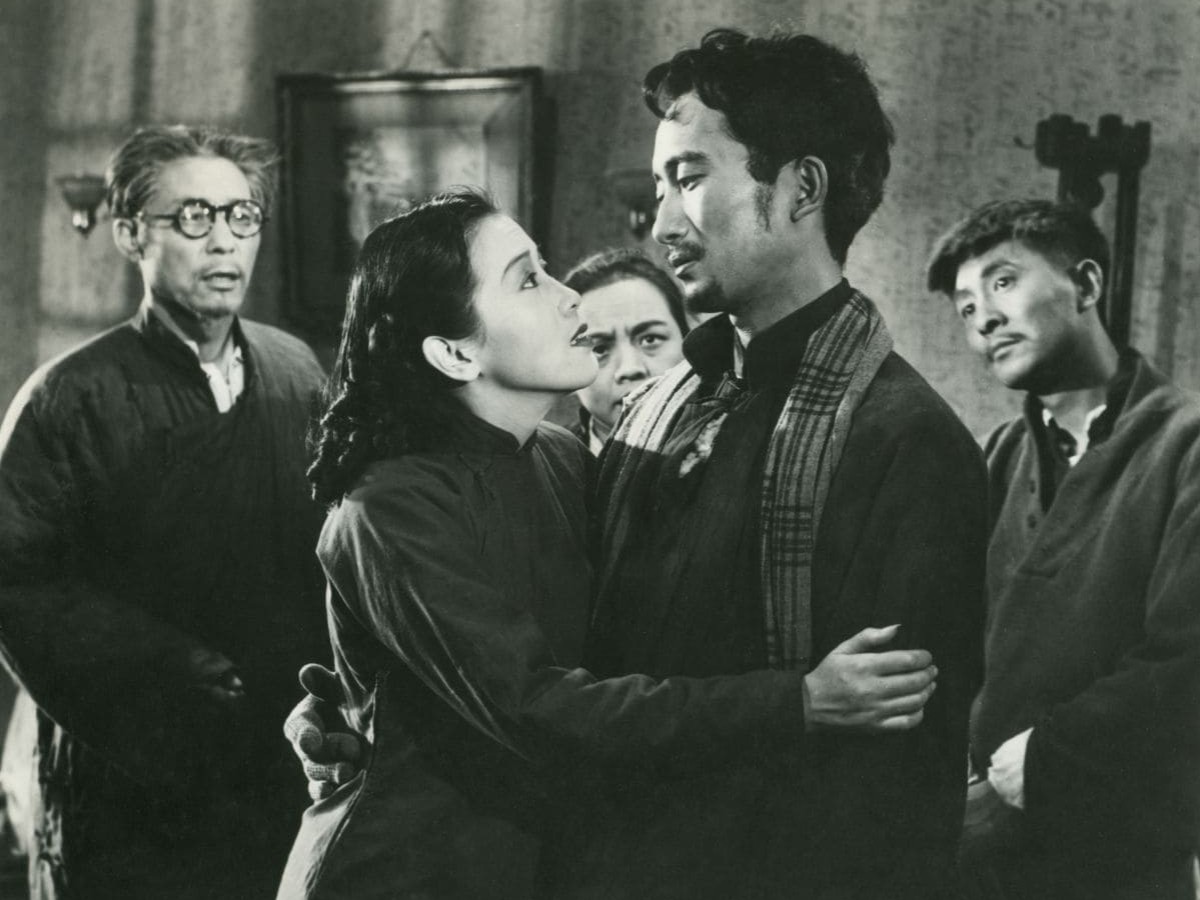
China's cinematic Golden Age briefly resumed after the end of the war against Japan. Some of China's greatest political and socially realist (melo-)dramas emerged from the cauldron of corruption, wild inflation, civil war, and ensuing chaotic KMT defeat and its withdrawal to Taiwan. The hugely popular epic A Spring River Flows East (1947) dramatized the war period for enormous middle-class audiences. Crows and Sparrows (1949) staged, in microcosm, the organic development of an uprising of oppressed Shanghai workers and intellectuals against their vulpine KMT exploiters.
There were also "entertainment" films of social mores and gender negotiation: the great writer Eileen Chang wryly satirized the patriarchy in Long Live the Missus (1947) and more gently in Sorrows and Joys of a Middle-Aged Man (1949). During this transitional period, the avant-garde film poet Fei Mu created his astonishing Spring in a Small Town (1948), an acutely aestheticized stream-of-consciousness backwater drama of sexual desire and social decay, which was decried as a "poisonous weed" by later leftist writers but which is now considered by many Chinese critics to be the greatest Chinese film ever made.
Everything changed after 1949. The Communist Party, victors in the Civil War, nationalized the film industry within three years, and created new government run film studios in Beijing, Changchun, and other metropolitan centers. Shanghai filmmakers who didn't flee to Hong Kong or Taiwan remained active, though. They were still sometimes able to produce subtly subversive dramas in the new politically "corrected” environment of rapidly congealing Marxist-Maoist orthodoxy. One of the earliest was the socially critical biography of a Beijing policeman This Life of Mine (1950), begun right at the end of KMT rule, though adjustments had to be made to the proto-social-realist film to please the now Communist censors under which it was completed and released.
Throughout the post-1949 political tumult – the Korean War, the relatively liberalizing Hundred Flowers movement (1956), the Anti-Rightist crackdown on perceived dissent (1957), and the disastrous Great Leap Forward – Chinese filmmakers continued to support the Party, mobilizing orthodox fiction film to function as political propaganda (following Mao's famous instructions that art was to serve the people, issued in his 1942 Talks at the Yenan Forum on Literature and Art).
But there were gaps and cracks through which subtle exceptions managed to slip. Early Spring (1963) manages to advocate anti-ideological "individualism" in its quiet quasi-romance of schoolteachers in a village. And Third Generation director Xie Jin's Two Stage Sisters (1965) combines Hollywood classicism, Soviet socialist realism, Shanghai melodrama, and local folk opera in a multi-voiced drama of female solidarity and resistance.
But this film could only find its audience after the disaster of the Cultural Revolution (1966-1976), whose fundamentalist Maoism shut down all but a few kinds of filmmaking (the exceptions being Madame Mao Jiang Qing's "revolutionary opera films") for ten long years. Film in China after 1978 will be the story of a remarkable aesthetic rebirth based on Shanghai's cinematic traditions, propelled by the older progressive filmmakers' sense of a national moral mission, and energized by a reawakened engagement with the outside world. (Shelly Kraicer)
In collaboration with the China Film Archive, the China Film Administration, and Huaxia Film Distribution. We would like to thank the China Film Archive for lending us all the digital copies for this retrospective.
The story of cinema in China starts just one year after the Lumière brothers’ first public screening in Paris: in 1896, a Frenchman projected the first "shadow plays" in China in the Xu Gardens, a Shanghainese entertainment complex. From then until the establishment of the People's Republic of China in 1949, cosmopolitan Shanghai remained the epicenter of the Chinese film industry and its modernist culture. From experiments in projection in the late Qing dynasty (a projector reportedly exploded in a test before the Empress Dowager Cixi was to enjoy a private screening) through the 1911 Revolution that overthrew the dynasty, the progressive 1919 May Fourth movement promoting modern intellectual enlightenment, the 1927 coup by Chiang Kai-shek's KMT (Chinese Nationalist Party), the Japanese invasion of Manchuria in 1931, Japan's occupation of Shanghai from 1937 to 1945, and the Civil War between the Communist Party of Mao Zedong and Chiang's KMT from 1945 to 1949, China and cinema developed together.
Shanghai's emerging cinema culture was an essential component of Shanghai modernism, the vanguard of China's 20th century cultural modernization. Early projections by European entrepreneurs in Shanghai and other Treaty Ports (outposts of European colonial rule on the Chinese mainland) brought Hollywood films (as well as films from France, Britain, and Russia) to Chinese audiences. At the same time, the Chinese film industry developed its "first generation" of directors, screenwriters, and actors.
Chinese comedies and films of exotic spectacle (martial arts fantasies, tales of ghosts and demons) were the first locally produced films to create a film-going audience of urban office workers. Shanghai's urban intelligentsia and bourgeoisie tended to frequent posher (and air-conditioned) cinemas showing the latest Hollywood productions. Two of the earliest films in this series illustrate this period: the spectacular short comedy Labourer's Love (1922), full of audience-wowing camera tricks and a bit of sexual innuendo, and The Cave of the Silken Web (1927), a zany excerpt from the traditional Ming dynasty novel Journey to the West, wherein seductive female spider-spirits capture and attempt to seduce a hapless monk and his companions.
Entertainments like these were soon censored by the conservative KMT authorities, who apparently feared their effect on public morality. What replaced them in the 1930s (now regarded as the first Golden Age of Chinese film) was a series of politically progressive, vitally engaged social melodramas that provoked a different kind of KMT censorship: repression based on political anxiety.
Left-wing literary movement writers and CCP-inspired cultural activists successfully incorporated themselves into key 1930s film studios (Mingxing and Lianhua being the most notable). They managed to infuse popular melodramas like Twin Sisters (1934), The Goddess (1934), and Street Angel (1937) with a mission of social engagement and a direct appeal to audience empathies with economically and politically oppressed Shanghaiers, especially female characters.
The sufferings of women – incorporated in glorious silent film stars like the glamorous Butterfly Wu (Hu Die, 1907–1989) and the tragically charismatic Ruan Lingyu (1910–1935) – became a standard trope in Chinese cinema that continues to this day. Suffering central female characters stood emblematically for the nation's long suffering under economic and external threat. KMT and foreign concession censorship prevented the occupying Japanese forces from being directly portrayed onscreen, but audiences knew how to read the foreign pirates, oppressive warlords, and their suffering female victims as synecdoche for national peril.
China's cinematic Golden Age briefly resumed after the end of the war against Japan. Some of China's greatest political and socially realist (melo-)dramas emerged from the cauldron of corruption, wild inflation, civil war, and ensuing chaotic KMT defeat and its withdrawal to Taiwan. The hugely popular epic A Spring River Flows East (1947) dramatized the war period for enormous middle-class audiences. Crows and Sparrows (1949) staged, in microcosm, the organic development of an uprising of oppressed Shanghai workers and intellectuals against their vulpine KMT exploiters.
There were also "entertainment" films of social mores and gender negotiation: the great writer Eileen Chang wryly satirized the patriarchy in Long Live the Missus (1947) and more gently in Sorrows and Joys of a Middle-Aged Man (1949). During this transitional period, the avant-garde film poet Fei Mu created his astonishing Spring in a Small Town (1948), an acutely aestheticized stream-of-consciousness backwater drama of sexual desire and social decay, which was decried as a "poisonous weed" by later leftist writers but which is now considered by many Chinese critics to be the greatest Chinese film ever made.
Everything changed after 1949. The Communist Party, victors in the Civil War, nationalized the film industry within three years, and created new government run film studios in Beijing, Changchun, and other metropolitan centers. Shanghai filmmakers who didn't flee to Hong Kong or Taiwan remained active, though. They were still sometimes able to produce subtly subversive dramas in the new politically "corrected” environment of rapidly congealing Marxist-Maoist orthodoxy. One of the earliest was the socially critical biography of a Beijing policeman This Life of Mine (1950), begun right at the end of KMT rule, though adjustments had to be made to the proto-social-realist film to please the now Communist censors under which it was completed and released.
Throughout the post-1949 political tumult – the Korean War, the relatively liberalizing Hundred Flowers movement (1956), the Anti-Rightist crackdown on perceived dissent (1957), and the disastrous Great Leap Forward – Chinese filmmakers continued to support the Party, mobilizing orthodox fiction film to function as political propaganda (following Mao's famous instructions that art was to serve the people, issued in his 1942 Talks at the Yenan Forum on Literature and Art).
But there were gaps and cracks through which subtle exceptions managed to slip. Early Spring (1963) manages to advocate anti-ideological "individualism" in its quiet quasi-romance of schoolteachers in a village. And Third Generation director Xie Jin's Two Stage Sisters (1965) combines Hollywood classicism, Soviet socialist realism, Shanghai melodrama, and local folk opera in a multi-voiced drama of female solidarity and resistance.
But this film could only find its audience after the disaster of the Cultural Revolution (1966-1976), whose fundamentalist Maoism shut down all but a few kinds of filmmaking (the exceptions being Madame Mao Jiang Qing's "revolutionary opera films") for ten long years. Film in China after 1978 will be the story of a remarkable aesthetic rebirth based on Shanghai's cinematic traditions, propelled by the older progressive filmmakers' sense of a national moral mission, and energized by a reawakened engagement with the outside world. (Shelly Kraicer)
In collaboration with the China Film Archive, the China Film Administration, and Huaxia Film Distribution. We would like to thank the China Film Archive for lending us all the digital copies for this retrospective.