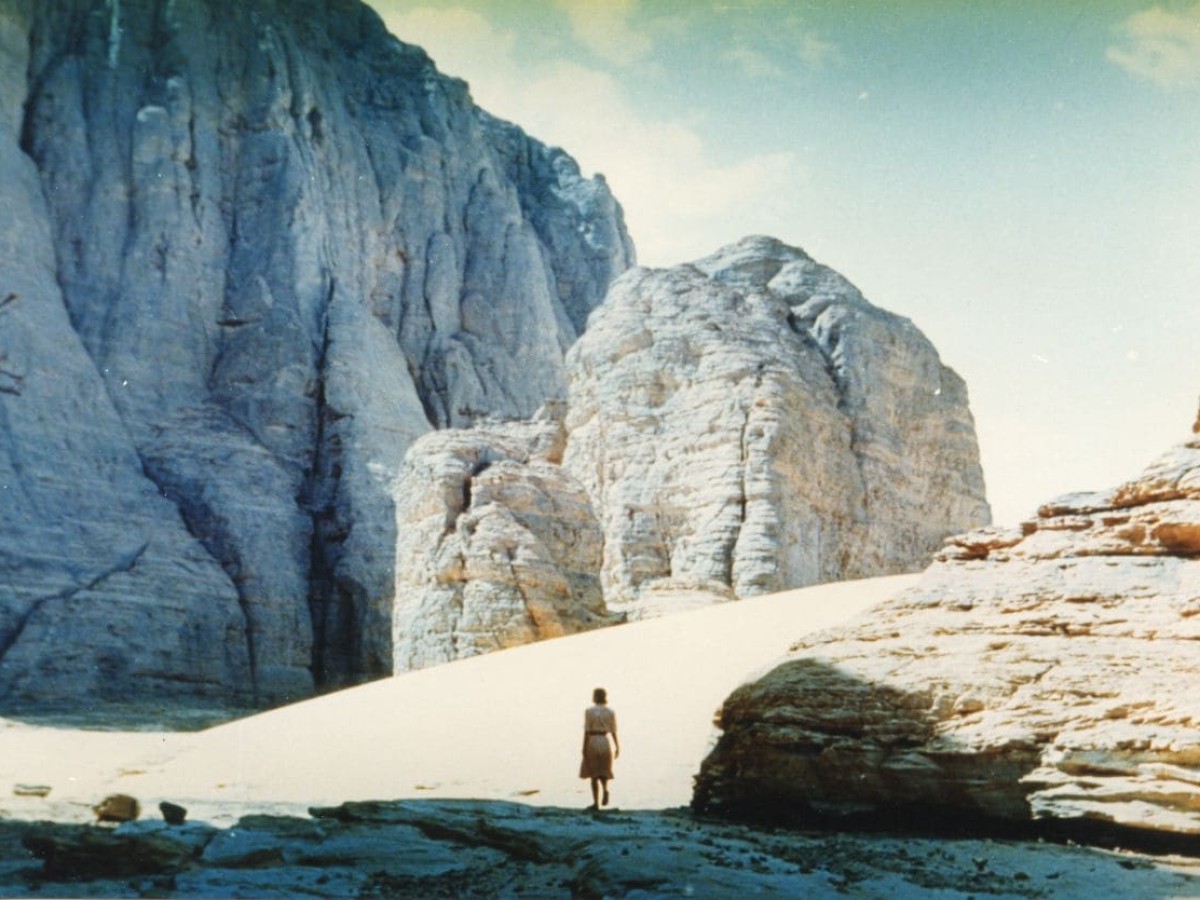
Collection on Screen:
RISE UP! Film – Form – Freedom
September 6 to October 21, 2026
The struggle for freedom is a cultural act, prophesied Amilcar Cabral at the Tricontinental Conference in solidarity with Africa, Asia, and Latin America in Havana in 1966. In Cuba, cinema was given a key role among the liberating cultural acts: here – and in the Global South – events were organized to discuss what a liberated (revolutionary) cinema could and should look like, and there were different opinions on the question of whether the moving image should be considered more as a representation, motor, or critique of culture and society. These understandings of filmmaking's political potential extended from cinema as montage (and construction) of reality to cinema as weapon of liberation from (colonial) dependencies.
Forty years after the conference in Havana, in 2006, Peter Sellars commissioned directors to make films for the New Crowned Hope Festival in Vienna. Inspired by Mozart's work, Sellars was interested in how the cinema of the Global South was able to transform contradictions into artistic solutions. Now, twenty years later, we combine selected works from these politically and socially dissimilar eras of Third Cinema, confronting Ritwik Ghatak's Bengali refugee epic Subarnarekha (1962) and the staging of the Ramayana epic in Opera Jawa (2006) by Garin Nugroho. We ask how Tomás Gutiérrez Alea's satire La muerte de un burócrata (1966) relates to Hamaca Paraguaya (2006) by Paz Encina, a work shaped by Mozart's Requiem. We want to trace the evolution of the Kurdish struggle for self-determination from Yılmaz Güney and Zeki Ökten's Sürü (1978) to Bahman Ghobadi's Niwemang (2006). We are interested in the contrast between Raymond Depardon's view of imprisonment in La Captive du désert (1989) and the perspective on retribution and forgiveness in Mahamat-Saleh Haroun's Daratt (2006). On World Children's Day, there is a short film program with selections from the documentary series Children of the World. (Tom Waibel / Translation: Ted Fendt)
In memory of Simon Field, who left his mark on the creation of these films as head curator and producer of the film section of the New Crowned Hope Festival during Mozart Year 2006.
The struggle for freedom is a cultural act, prophesied Amilcar Cabral at the Tricontinental Conference in solidarity with Africa, Asia, and Latin America in Havana in 1966. In Cuba, cinema was given a key role among the liberating cultural acts: here – and in the Global South – events were organized to discuss what a liberated (revolutionary) cinema could and should look like, and there were different opinions on the question of whether the moving image should be considered more as a representation, motor, or critique of culture and society. These understandings of filmmaking's political potential extended from cinema as montage (and construction) of reality to cinema as weapon of liberation from (colonial) dependencies.
Forty years after the conference in Havana, in 2006, Peter Sellars commissioned directors to make films for the New Crowned Hope Festival in Vienna. Inspired by Mozart's work, Sellars was interested in how the cinema of the Global South was able to transform contradictions into artistic solutions. Now, twenty years later, we combine selected works from these politically and socially dissimilar eras of Third Cinema, confronting Ritwik Ghatak's Bengali refugee epic Subarnarekha (1962) and the staging of the Ramayana epic in Opera Jawa (2006) by Garin Nugroho. We ask how Tomás Gutiérrez Alea's satire La muerte de un burócrata (1966) relates to Hamaca Paraguaya (2006) by Paz Encina, a work shaped by Mozart's Requiem. We want to trace the evolution of the Kurdish struggle for self-determination from Yılmaz Güney and Zeki Ökten's Sürü (1978) to Bahman Ghobadi's Niwemang (2006). We are interested in the contrast between Raymond Depardon's view of imprisonment in La Captive du désert (1989) and the perspective on retribution and forgiveness in Mahamat-Saleh Haroun's Daratt (2006). On World Children's Day, there is a short film program with selections from the documentary series Children of the World. (Tom Waibel / Translation: Ted Fendt)
In memory of Simon Field, who left his mark on the creation of these films as head curator and producer of the film section of the New Crowned Hope Festival during Mozart Year 2006.
Related materials
Program CoS: RISE UP! - Oct / Nov 2022