In Person:
Josef Dabernig
October 14 to 21, 2026
Shortly after his 70th birthday, we celebrate Austrian artist Josef Dabernig with a complete retrospective of his films, expanded by a carte blanche and a glimpse into his work in other domains, including performance readings and slide projections. With their presence at festivals and in exhibition spaces, the total of 22 short films which Dabernig has made since the mid-1990s – a handful in collaboration with other artists – represent the most well-known part of his creative output, but they belong to a larger multimedia oeuvre, to which the subtitle of the first Dabernig monograph already referred: Film, Photo, Text, Object, Construction. Dabernig moved to Vienna in 1975 to study sculptural practice, and his moving image work expands this into "spatial sculpture." At the same time, for all their structural clarity, these are also fiction films in the literal sense: not purely abstract conceptual art, but instead tragicomic miniatures, using Dabernig's unmistakable laconicism to present situations full of absurd humor and melancholy, which are enriched by autobiographical references and explore aesthetic and private interests – from architecture to sweets.
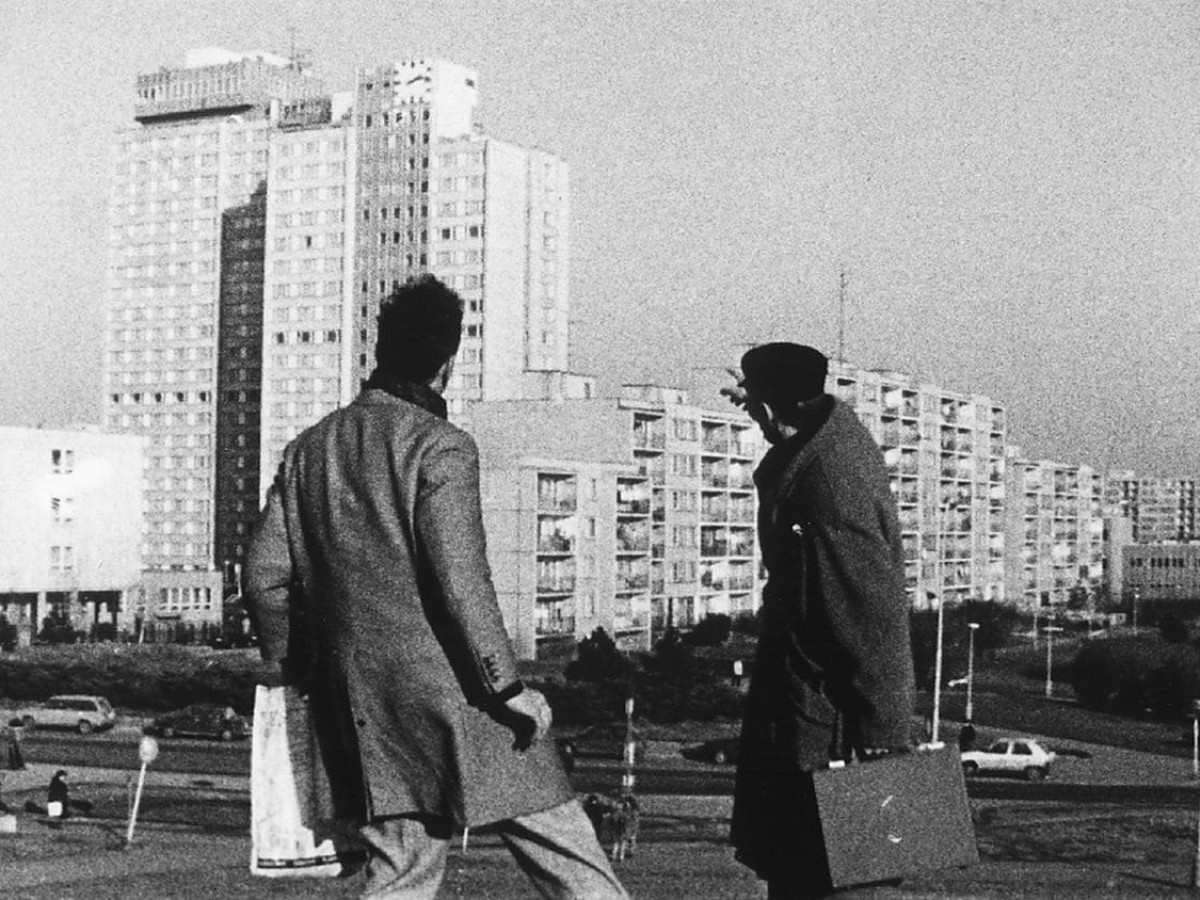
Dabernig's background in the Carinthian market town Kötschach-Mauthen near the Italian and Slovenian (formerly: Yugoslavian) borders can also be seen as a starting point for his work: selected sites in Eastern Europe, Austria, and Italy serve as fertile filming locations for his studies of life in a (post-)modern world which often produces alienation and emptiness. His protagonists have mostly settled into everyday habits, their activities and movements become slowly ritualized acts: loneliness reigns in togetherness, there are interactions, but no communication in the conventional sense. As a consequence, the films are often wordless or counterpointed by external texts, for instance when the proletarian bleakness in the images of the gambling addiction story Herna (2010) encounter a bourgeois literary radio drama by Bruno Pelladini. Dabernig's early anti-football triumph Wisla (1995) intensified its humor by contrasting instructions by hand signals from lonely trainers in an empty Polish stadium with a soundtrack of screaming Italian football fans. Since Rosa coeli (2004), Dabernig has collaborated with sound designer Michael Palm on carefully created acoustic spaces consisting of sound effects, speech, and a variety of music, which take on a dialectical relationship to the visuals: sometimes with, sometimes against the images.
"Dialectics" is actually a key concept for Dabernig's work, whose tonal range runs from pleasant melancholy to enjoyable oddness, while almost monomaniacal preferences nevertheless emerge out of the films' narrative diversity: again and again family films, car films, hotel films, landscape films, work films (but also leisure films), etc., and many often all at once, as demonstrated, for example, with near-crystalline clarity in the family survey Hotel Roccalba (2008). (Christoph Huber / Translation: Ted Fendt)
With Josef Dabernig in attendance
In collaboration with sixpackfilm and the Kontakt Collection (Kontakt Collection is an independent non-profit art Association for the Promotion of Central, Eastern and Southeastern European Art, founded by ERSTE Foundation in cooperation with Erste Group.)
Shortly after his 70th birthday, we celebrate Austrian artist Josef Dabernig with a complete retrospective of his films, expanded by a carte blanche and a glimpse into his work in other domains, including performance readings and slide projections. With their presence at festivals and in exhibition spaces, the total of 22 short films which Dabernig has made since the mid-1990s – a handful in collaboration with other artists – represent the most well-known part of his creative output, but they belong to a larger multimedia oeuvre, to which the subtitle of the first Dabernig monograph already referred: Film, Photo, Text, Object, Construction. Dabernig moved to Vienna in 1975 to study sculptural practice, and his moving image work expands this into "spatial sculpture." At the same time, for all their structural clarity, these are also fiction films in the literal sense: not purely abstract conceptual art, but instead tragicomic miniatures, using Dabernig's unmistakable laconicism to present situations full of absurd humor and melancholy, which are enriched by autobiographical references and explore aesthetic and private interests – from architecture to sweets.
Dabernig's background in the Carinthian market town Kötschach-Mauthen near the Italian and Slovenian (formerly: Yugoslavian) borders can also be seen as a starting point for his work: selected sites in Eastern Europe, Austria, and Italy serve as fertile filming locations for his studies of life in a (post-)modern world which often produces alienation and emptiness. His protagonists have mostly settled into everyday habits, their activities and movements become slowly ritualized acts: loneliness reigns in togetherness, there are interactions, but no communication in the conventional sense. As a consequence, the films are often wordless or counterpointed by external texts, for instance when the proletarian bleakness in the images of the gambling addiction story Herna (2010) encounter a bourgeois literary radio drama by Bruno Pelladini. Dabernig's early anti-football triumph Wisla (1995) intensified its humor by contrasting instructions by hand signals from lonely trainers in an empty Polish stadium with a soundtrack of screaming Italian football fans. Since Rosa coeli (2004), Dabernig has collaborated with sound designer Michael Palm on carefully created acoustic spaces consisting of sound effects, speech, and a variety of music, which take on a dialectical relationship to the visuals: sometimes with, sometimes against the images.
"Dialectics" is actually a key concept for Dabernig's work, whose tonal range runs from pleasant melancholy to enjoyable oddness, while almost monomaniacal preferences nevertheless emerge out of the films' narrative diversity: again and again family films, car films, hotel films, landscape films, work films (but also leisure films), etc., and many often all at once, as demonstrated, for example, with near-crystalline clarity in the family survey Hotel Roccalba (2008). (Christoph Huber / Translation: Ted Fendt)
With Josef Dabernig in attendance
In collaboration with sixpackfilm and the Kontakt Collection (Kontakt Collection is an independent non-profit art Association for the Promotion of Central, Eastern and Southeastern European Art, founded by ERSTE Foundation in cooperation with Erste Group.)